
A plan doesn't need to be elaborate. It needs five short answers, written down before you start — because the plan is what keeps you from quietly sliding back into passive content consumption halfway through.
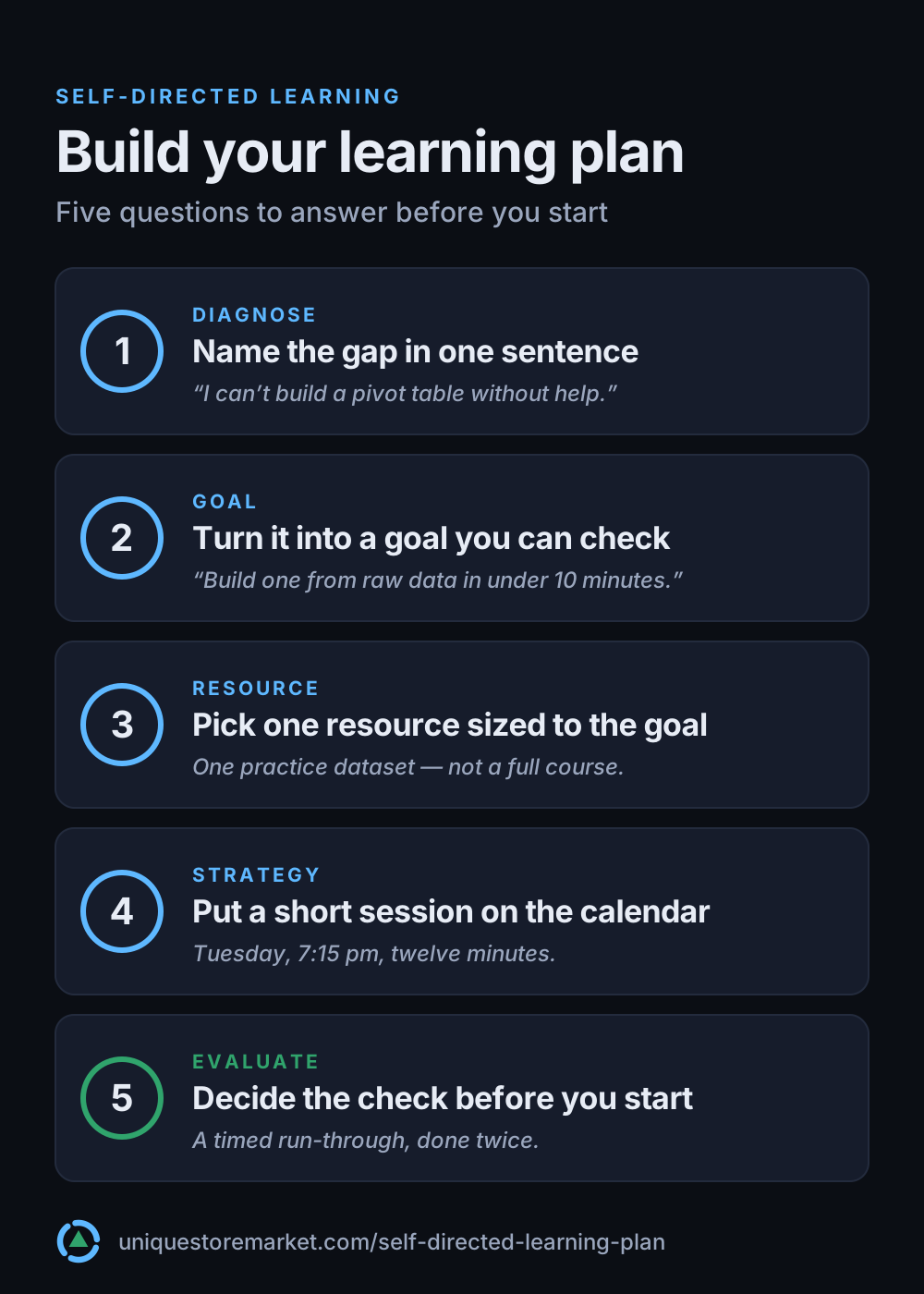
Write down exactly what you can't yet do, not the topic you want to "get better at." "Get better at Excel" isn't a diagnosis; "I can't build a pivot table from a raw export without looking it up" is. If you can't write the gap as a single concrete sentence, you haven't diagnosed it yet — spend ten minutes trying to actually do the thing and noting exactly where it breaks.
Take the sentence from Step 1 and flip it: what would "closed" look like, specifically enough that you or someone else could watch you do it and agree it counted? "Build a working pivot table from a raw data dump in under ten minutes" is checkable. "Understand pivot tables better" is not.
Resist the urge to enroll in a full course for a narrow gap. Look for the smallest resource that closes exactly this goal — one article, one practice dataset, one person who already does this and will answer three questions. A resource that also covers ten things you already know is the wrong size.
Decide how you'll actually work the resource — reading, drilling, building something, rehearsing out loud — and block a specific short session for it. "This week sometime" doesn't happen; "Tuesday, 7:15pm, twelve minutes" does. This is also where the framework's micro-start rule earns its keep: make the first session small enough that skipping it feels sillier than doing it.
Write down, in advance, exactly how you'll know it worked — a recording you'll listen back to, a timed run-through, a real conversation with someone who'll push back. Deciding this upfront matters because it's tempting to skip evaluation once the practice feels like "enough" — and skipping it is how a plan quietly turns back into passive consumption.
Five short lines is a complete plan: the gap, the goal, the resource, the session on the calendar, and how you'll check it. Nothing here requires a framework, a template, or software — just five honest answers, ideally written down somewhere you'll actually look again.
The five steps above close one gap. If you're learning a whole topic, turn the goal into a short sequence of milestones instead. Five to nine is enough for almost any topic. Order them from the most basic to the most applied, and give each one its own small outcome ("I can ___") and a rough time estimate. Every milestone should end in something you did, not something you read. The gap you diagnosed usually becomes one or two milestones, not the whole plan. The rest covers what has to come before and after it.
For example, a plan for negotiating a raise might run: know your number, build your evidence, open the conversation, handle a counter-offer, close and get it in writing, then do a full mock negotiation from start to finish. The counter-offer milestone gets the most time, because that's where the gap was. Chapter 3 of the full guide walks through this in detail.
Here is one complete plan, so you can see how short the answers can be. It's for someone with a trip coming up who can read basic Spanish but can't hold a conversation.
Notice what the plan leaves out. There's no grammar book, no app streak, no "become fluent". It aims at the two situations the trip actually needs, and the evaluation is something you can't fake. For five more plans like this one, see 5 real examples of self-directed learning.
1. It names a topic instead of a gap. "Learn Spanish" or "get better at Excel" can't be planned, because there's no point where it's finished. Go back to Step 1 and write what you can't yet do.
2. The resource is course-sized. A forty-hour course for a two-hour gap means most of your time goes to things you already know, and the plan stalls in week two.
3. The session has no time attached. "This week sometime" is the most common reason a plan never starts. A day, a time and a length turn it into an appointment.
4. The evaluation is decided afterwards. Once practice feels comfortable, any test you invent will be one you can pass. Decide the check while you still don't know the answer.
The five questions with space to write, a milestone table (five to nine milestones, each with a time estimate) and a session log. You can print it or type straight into it on a computer. No email required.
For one gap, five lines: the five steps above. For a whole topic, add five to nine milestones. If the plan doesn't fit on one page, it's probably a reading list, not a plan.
Long enough to reach the evaluation in Step 5, and no longer. One narrow gap often takes a few short sessions over a week or two. A larger topic, broken into milestones, can run for a month. At that point, set a review date halfway through.
No. Five honest answers on paper are enough. The template's real job is to stop you skipping Step 5, because it has a box for the evaluation that stays empty until you fill it in.
If writing all five from scratch feels like a lot, there's a structured prompt that walks you through each step with an AI, three short questions to start, and produces the plan as you go.
Get the AI promptThe five-day guide covers all five steps with a worked example and checklist each — plus a free printable PDF version.
Get the free PDFWhat is self-directed learning? · What does "self-directed learning" mean? · The benefits of self-directed learning · 5 real examples of self-directed learning